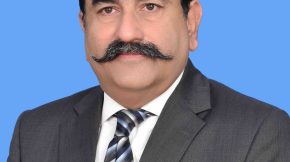


ISLAMABAD (Digital Posts) Beyond the Files: Anil Saeed and the Work Islamabad Needs

Share

By Saqib Khan Khattar
ISLAMABAD (Digital Posts) There is a familiar problem with public institutions in Pakistan: they are often better at explaining why something cannot be done than finding a way to get it done. Files move slowly, decisions are deferred, citizens are sent from one office to another, and routine administrative matters acquire the dimensions of major bureaucratic battles.
It is against this backdrop that the arrival of Anil Saeed as Deputy Commissioner in the Capital Development Authority (CDA) deserves attention.
After a considerable period, the CDA appears to have found in Anil Saeed an officer who wants to work. For him, public service should mean more than signing files, attending official meetings or maintaining a visible presence in the administrative hierarchy. It should be measured by decisions taken, problems resolved and responsibilities discharged.
Work, work and more work.
It is a simple proposition, but one that carries considerable significance in a system where administrative activity is not always matched by public results.
The CDA is no ordinary government department. As the principal civic and development authority of the federal capital, its decisions shape the everyday experience of Islamabad’s residents. From land administration and urban planning to public spaces, roads, encroachments and municipal services, the institution exercises responsibilities that extend well beyond the confines of its offices.
Consequently, the performance of its officers matters.
A citizen approaching a public office does not necessarily understand the administrative divisions, internal procedures or jurisdictional boundaries that govern its functioning. He or she arrives with a problem and expects the state to provide an answer. Yet, too often, citizens are made to navigate the institution themselves, carrying applications from one desk to another in search of someone willing to take ownership.
This is where administrative leadership makes a difference.
A capable officer does not merely supervise the movement of files. He ensures that decisions are made within the law, that responsibilities are clearly assigned and that unnecessary delays do not become an accepted feature of official business.
For Anil Saeed, the challenge will be to translate his apparent appetite for work into an institutional culture that values efficiency, fairness and accountability.
The first test should be accessibility. A public office must not become an intimidating place where a citizen’s ability to secure attention depends on personal connections or influence. A legitimate complaint deserves consideration regardless of the social standing of the person submitting it.
The second is consistency. Rules must apply equally, whether the matter concerns an ordinary resident or an influential individual. Administrative discretion is a responsibility, not a licence to favour one citizen over another.
The third is the ability to distinguish between activity and achievement. Pakistan’s bureaucracy has no shortage of meetings, inspections, official photographs and written instructions. What it often lacks is a clear connection between these activities and improvements in public service delivery.
An officer’s performance should therefore be judged by tangible outcomes: how quickly pending matters are addressed, whether complaints receive meaningful responses, whether decisions withstand legal scrutiny and whether citizens experience a measurable improvement in dealing with the institution.
Islamabad, despite its planned avenues and carefully designed sectors, is not merely a showcase for the state. It is a living city, home to families, workers, traders, property owners and people whose daily concerns rarely feature in official presentations. Their problems deserve the same seriousness as major development schemes.
For the CDA, this also means strengthening coordination between departments, addressing administrative bottlenecks and ensuring that the law is implemented without discrimination. No individual officer can resolve every institutional weakness overnight. But effective leadership can establish priorities, demand performance and create an environment in which public responsibility is taken seriously.
It would be premature to declare any officer successful on the basis of an encouraging beginning. Public confidence is earned through sustained performance, not official introductions or flattering headlines. Anil Saeed, like every public servant, must ultimately be judged by the quality of his decisions and the difference they make to people’s lives.
Yet, there is value in recognising an attitude that places work at the centre of public office. At a time when citizens have grown accustomed to delays and bureaucratic indifference, an officer’s willingness to take responsibility is a welcome starting point.
The real measure of his tenure will not be how many meetings he attends or how frequently his activities appear in the news. It will be whether an ordinary citizen finds the CDA more accessible, whether legitimate grievances are addressed without unnecessary delay, and whether the institution becomes more responsive to the people it is meant to serve.
Government positions are temporary. Official vehicles, protocol and authority eventually pass to someone else. What remains is the public memory of how an officer treated people and whether he used his authority to make their lives easier.
Anil Saeed has an opportunity to build that kind of legacy at the CDA.
**The message is simple: Islamabad needs less bureaucratic routine and more purposeful action. Beyond the files, beyond the meetings and beyond the official protocol, there is a city waiting for its institutions to deliver.
And that is where the real work begins.
Work, work and more work.