
ISLAMABAD (Digital Posts) Shared Aspirations: How Common Values of Peace, Development and Respect Shape Pak-China Ties

Share
Written By Ms. Maryam Khan, a Participant of ICSF-SBBWU Fellowship Programme 2026-2027
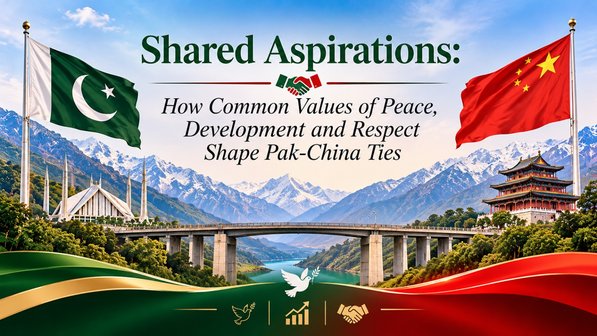
ISLAMABAD (Digital Posts) The Pakistan-China relationship is the textbook example of a state-to-state relationship and is based on an All-Weather Strategic Cooperative Partnership. Both sides have referred to it as an unbreakable bond which is ‘higher than the mountains and deeper than the oceans’. It is a relationship which is not contingent upon the political tides at home or abroad. It is not simply a relationship built on a series of deals. The basis of the relationship is the shared desire for peace, shared desire for development and mutual respect.
China and Pakistan are not only all-weather strategic cooperative partners but also a mainstay in upholding international fairness and justice. We are ready to work hand in hand with China to stand on the right side of history and on the side of humanity’s common interests, take the lead in upholding principles and justice, pursuing peace and promoting development, unite all peace-loving countries and people around the world, follow the four-point proposition put forward by President Xi Jinping, continue to implement the five-point China-Pakistan initiative and make unremitting efforts to promote peace, stability and lasting security in the Middle East and make greater contributions to building a community with a shared future for mankind.
The joint defense of national sovereignty is a fundamental principle of the alliance. Pakistan is very much committed to the one China principle (with respect to Taiwan, Xinjiang, Xizang and Hong Kong). In turn China has always supported Pakistan’s national independence, its territorial integrity and its position on the peaceful settlement of the Jammu and Kashmir issue. In the current global climate the two countries are working in tandem to resolve wider geopolitical conflicts. Pakistan and China have been in perfect sync on the diplomatic front in respect of a number of issues in the region, from the pursuit of peace to counter-terrorism, with both countries advocating the same position through organizations such as the Shanghai Cooperation Organization (SCO). The economic blueprint of Pak-China relations is all about getting millions out of poverty and modernizing the state’s infrastructure. That’s how it’s going to be achieved through structural connectivity.
As the cornerstone of China’s Belt and Road Initiative (BRI), the China-Pakistan Economic Corridor (CPEC) has now evolved into CPEC 2.0. Rather than simply being about the construction of the basic transport and energy infrastructure, CPEC 2.0 is about deeper integration in the areas of AI, industrialization, green agriculture and advanced mining. It has added thousands of megawatts of electricity to the national grid through power plants, coal, solar, and hydro projects, easing chronic blackouts.
Built and upgraded thousands of kilometers of highways, the modern railway lines, and mass transit systems like the Lahore Metro Train. It transformed the deep-sea Gwadar Port and its surrounding airport into a regional trade and logistics hub. It is also projected to lift annual GDP growth by an estimated 2% to 2.5% and reduce internal logistics and transport costs.
It is generating hundreds of thousands of direct and indirect jobs across early infrastructure phases and current Special Economic Zones (SEZs). Moreover, it transitioned from initial hard infrastructure to focus on agricultural modernization, green energy, industrial cooperation, and digital linkages.
Apart from this, it bypasses the vulnerable Malacca Strait by routing oil and goods through Gwadar and overland through Pakistan to western China, cutting thousands of kilometers off transit distance and time. It provides China’s landlocked western provinces (like Xinjiang) with a direct, reliable gateway to the Arabian Sea and global shipping lanes. It also advances China’s broader Belt and Road Initiative by knitting together South Asia, Central Asia, and Western China into an interdependent economic bloc. Furthermore, it opens large-scale contracts, construction orders, and export markets for Chinese engineering, manufacturing, and technology firms and fosters a deeper bilateral “all-weather” partnership with Pakistan, securing a friendly anchor state along its western periphery.
Pakistan is fully on board with President Xi’s Global Development Initiative (GDI) and Global Security Initiative (GSI). They are in line with Pakistan’s own longer-term objectives of becoming a geoeconomics hub by linking the Central Asian economies to the Arabian Sea.
What sets this partnership apart from the historical superpower or client relationship is a culture of sovereign equality and mutual trust. Both states are fully committed to the Five Principles of Peaceful Coexistence and will in no way interfere in each other’s internal affairs. They are very different in terms of size of economy, form of government and culture, and yet they are genuine peers. The ultimate marker of this trust is the expanding frontier of technical cooperation. That goes well beyond the normal stuff of defense and financial assistance to encompass joint space missions which will see Pakistani astronauts flying into space alongside Chinese astronauts.
Through their jointly agreed 2025-2029 Action Plan, Pakistan and China are very explicitly enshrining these principles. They are turning mutual respect into tangible socio-economic development and a combined voice for peace on the world stage. It’s another powerful chapter in the history of international cooperation written by the two ‘Iron Brothers’.