
ISLAMABAD (Digital Posts) Women as Bridge-Builders: Untold role of Women in Pakistan-China Cultural Exchange

Share
Written By Ms. Ishrat Bano, a Participant of ICSF-SBBWU Fellowship Programme 2026-2027
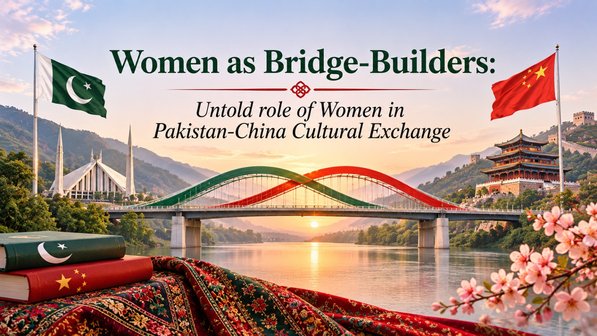
ISLAMABAD (Digital Posts) The bond of friendship between Pakistan and China is generally conveyed in terms of diplomatic visits, strategic cooperation and connectivity between the two nations. But yet again a different story should be told, one about the women who make this relationship relevant in day-to-day life. They don’t show up in the official photos that often but they make an impact in classrooms, on campuses, in cultural centrers and in the discussion! The explanations of an unknown expression by a language teacher, the description of her experience abroad by a student and the challenge of a stereotype by a researcher can contribute to bridging two societies. Their work brings us to the understanding that friendship between countries is not only based upon agreements made between the governments but also on the trust established among people.
Part of this bridge building is of an institutional origin. One study conducted by the National Defence University (NDU) in Pakistan states that Bao Jiqing, the head of the Chinese Embassy Women Group, started a China Culture Camp in Islamabad, Pakistan in 2014. There were around forty students that participated in activities on Chinese language, music and traditional calligraphy. These projects may be small and insignificant compared with the big ones in the economy but they are important in making another culture accessible. The first time that a young person writes Chinese or hears Chinese music, he or she might find one unknown land to be a land of curiosity and friendship. Here, it wasn’t just women going on cultural diplomacy, it was women who were organizing cultural diplomacy.
Another window into this little known relationship is education. The Pakistani students studying in China are students but at the same time the study experience provides opportunities for informal cultural exchange. Discussions with peers with regard to religious observance, family goals and career objectives can bring up differences without causing divisions. In 2026, interviews with 17 Pakistani female postgraduate students in China revealed that negotiation of family approval was based on concepts of honor, safety and acceptable mobility. The following stories reveal that it takes a lot of determination to meet an overseas classroom. Cultural exchange starts on the ground, in the process of negotiations about whose dreams are being fulfilled.
This is particularly true for language learning. In 2016, it was reported that there were five women out of eleven Chinese teachers at the University of Karachi. Eleven students of girl’s college and two teachers of Sindh Madressatul Islam University went to China for internship, as reported. These examples provide a helpful counterpoint to the stories that tell of exchange as a preeminently male enterprise. Language learning opens up opportunities for questions which so often are not addressed in formal meetings: how is respect expressed, how is belonging described. These experiences, in which women play an active role, realize more personal communication and offer women chances to influence their own education and career path.
These opportunities can be extended beyond the type of universities that are often linked with international cooperation, such as women’s universities. One such example is the setting up of China Study Centre at Sardar Bahadur Khan Women’s University in Quetta. On the occasion of the opening, participants linked language education with a better relationship between people and the Chinese consul in the city pledged support for the centre and the provision of Chinese teachers. The bigger picture to be learned from this is that cultural diplomacy techniques are more representative when the institutions of cultural diplomacy make it to women outside of the comfortable metropolitan circles. A fruitful collaboration should enable students of Balochistan and other neglected areas to be part of the celebration process and not spectators.
Dr Rukhsana Iftikhar presented her own research on ‘Sociocultural cooperation’ at the academic exchange held at Punjab University in 2023 and Dr Ge Yangling from Communication University of China presented a report on ‘Women’s development’. This engagement can provide a basis for further partnership building. The experiences of women when not in the ceremonial setting could be explored through joint research, documentary projects and oral history. Instead of just asking for compliments on bilateral relations, researchers and journalists should have participants reflect on the adjustment, misunderstanding, achievement and disappointment that they have experienced.
The next step is therefore, should be practical. Institutions of higher education and cultural institutions should create long-lasting exchanges, scholarships that are available on a year-round basis and mentoring networks and not just on a visit-by-visit basis. Programs must cover safety questions and questions about where to stay and what about the children and their families as well as being able to tackle them but not use them as an excuse to exclude. Women’s priorities should be established in the program, they should be in the lead to conduct the research and to assess the outcomes. The success should not be solely based on attendance and pictures but on the ongoing collaboration and enhancing language confidence and opportunities for participants to use. Cultural exchange is enhanced when women are identified as decision makers with a diversity of interests rather than a category of culture.
To conclude, the untold story of women’s role in Pakistan – China cultural exchange is the story of the humanizing of international relations. It reminds us to see the classroom, to see the conversation that we share and to see the hard and yet still good choice of studying abroad. But it doesn’t imply a woman’s role to make everything harmonious, when she recognizes the work. It should mean making their accomplishments known, their viewpoints powerful and their initiatives sustained. A bridge is useful as it can be traversed forwards or backwards. This should be the basis for a more accommodating cultural cooperation between Pakistan and China.