
ISLAMABAD (Digital Posts) Global demand for Pakistani JF-17 Thunder fighter jets is increasing

Share
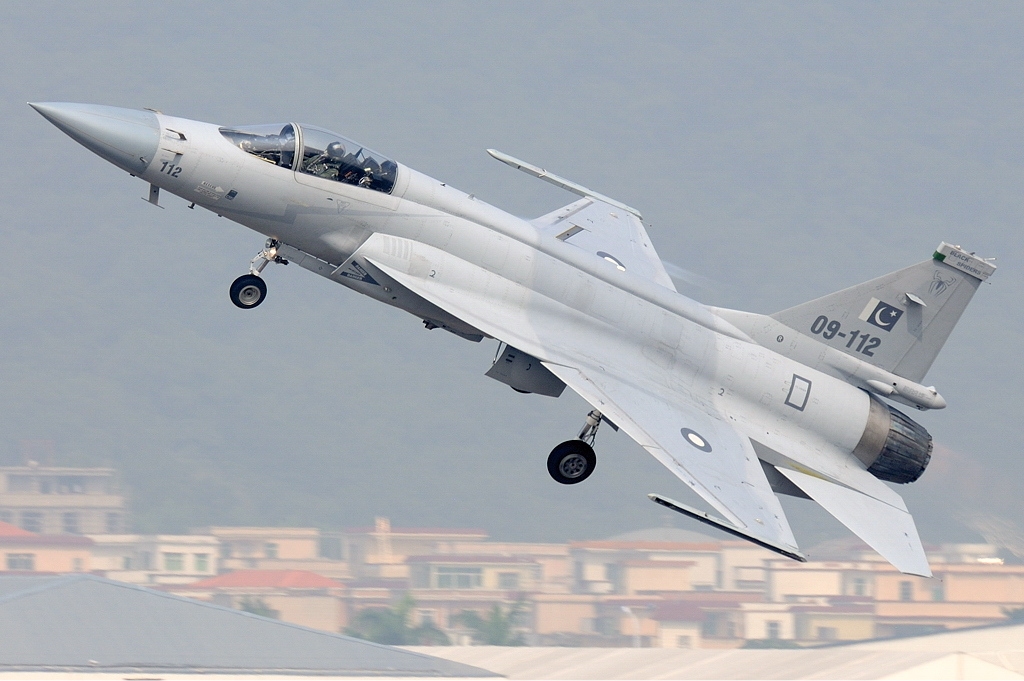
ISLAMABAD (Digital Posts) The success of Pakistan’s arms industry can change the course of the country’s economy.
During the four-day conflict with India in May last year, Pakistan not only proved the effectiveness of Chinese-made military equipment but also demonstrated the capabilities of its indigenously developed weapons, such as the JF-17 Thunder fighter jet, Al-Khalid main battle tank, and Fateh series guided multi-launch rocket system. In particular, the JF-17 Thunder proved its combat capability during clashes with India in May last year and 2019. In last year’s war, this aircraft was credited with destroying the Indian Air Force’s advanced S-400 surface-to-air missile system at Adampur. The JF-17 also performed well at the Dubai Air Show. In February 2003, the first aircraft of the J-10 design was handed over to the 13th Test Regiment of the Chinese Air Force. In December 2003 of the same year, the fighter was declared ‘operational’ (in usable condition). Work on the aircraft continued for eighteen years. The ‘J-10C’ aircraft began combat service in April 2018. Initially, the aircraft was developed for the People’s Liberation Army and Air Force, but later the Chinese arms industry also started manufacturing it for export purposes. The Pakistani Air Force had been planning to replace its squadron of Mirage aircraft since the Musharraf era, which it had purchased in 1967. Two things are most important in an aircraft: one is its airframe structure, and the other is its avionics. Talking about the J10C’s airframe, it has a delta-canard configuration that improves its agility, due to which the aircraft can quickly change its angle of attack. Secondly, its structure is made of composite material, due to which, although it is not a stealth aircraft, it becomes difficult to detect on radar. The other important thing about this aircraft is its engine, which is the AL-31FN, which is difficult to jam. Active SSR radar (ASR) is currently the most advanced radar. Its target tracking is good, and it can tell the difference between enemy and own aircraft. And it has a data link facility, which means that you can share data not only with aircraft in formation, but you can also share your data with AWACS, UAVs, and AWCs. These data links are made in Pakistan. The cockpit of this aircraft has good aerodynamics, that is, ease of flying, which makes it easy for the pilot to operate the cockpit and does not burden him with flying, but rather focuses on how to operate the radar and how to use the weapons.
Pakistan has accelerated its defense outreach in recent months as it seeks to increase arms exports and make its local defense industry profitable. Khawaja Asif said that our aircraft have been tested in battle and are receiving enough orders that Pakistan will not need the IMF in six months. A brief timeline is being given for Pakistan’s defense agreements and negotiations after May 2025 that have been signed or are under consideration with friendly countries. January 10, 2026: Iraqi Air Force shows keen interest in JF-17
Lt. Gen. Muhand Ghalib Muhammad Razi Al-Asadi, Commander of the Iraqi Air Force, while speaking during a meeting with Pakistan Air Force Chief Air Chief Marshal Zaheer Ahmed Babar Sidhu during his visit to Iraq, praised the professionalism of the Pakistan Air Force against India in May and expressed interest in acquiring JF-17 Thunder aircraft.
According to the ISPR, the Iraqi Air Force chief expressed special interest in benefiting from the Pakistan Air Force’s world-class training and in the JF-17 Thunder and Super Mushtaq training aircraft.
January 7: JF-17 deal under consideration with Saudi Arabia in exchange for loans
According to the British news agency Reuters, talks are underway between Pakistan and Saudi Arabia to convert Saudi loans worth about $2 billion into a deal for JF-17 fighter jets. According to Pakistani sources, the total value of the deal could be $4 billion, which will also include additional defense equipment.
January 6: Bangladesh is interested in buying JF-17
The air force chiefs of Pakistan and Bangladesh held detailed discussions on the possible purchase of JF-17 Thunder aircraft. According to the ISPR, Air Chief Marshal Zaheer Ahmed Babar Sidhu briefed his Bangladeshi counterpart on the recent developments of the Pakistan Air Force and assured training and technical cooperation. December 22, 2025: Pakistan signs a multi-billion-dollar defense deal with Libya
Pakistan has signed a multi-billion-dollar deal to sell conventional military equipment to Libya. According to Reuters, the deal includes the sale of JF-17 fighter jets and Super Mushtaq training aircraft. According to a Pakistani official, the deal includes land, naval, and air equipment and will be completed in two and a half years. The deals reflect the fact that Pakistan’s defense industry is rapidly making its mark on the global stage, and the JF-17 Thunder is becoming a central pillar of this success. The JF-17’s market value has increased because it is “tested and used in combat.” Pakistan has signed deals with six countries for the supply of equipment, including Saudi Arabia, for the JF-17 and electronic and weapons systems for the aircraft. The Saudi-Pakistan Mutual Defense Agreement, signed in September, committed both sides to consider aggression against either country as an attack on both, further strengthening the decades-old security partnership. Pakistan has long provided military assistance to the Saudi kingdom, including training and advisory deployments, while Saudi Arabia has repeatedly provided financial assistance to Pakistan during times of economic pressure. In 2018, Riyadh announced a $6 billion aid package for Pakistan, which included a $3 billion deposit with the central bank and $3 billion in oil on deferred payment. Saudi Arabia has since rolled over the repayment period several times, including a $1.2 billion extension last year, helping Islamabad shore up its foreign exchange reserves amid chronic balance of payments pressures. Last month, Pakistan signed an arms deal worth more than $4 billion with Libya’s eastern-based Libyan National Army, officials said, one of the country’s largest arms sales to date, including JF-17 fighter jets and training aircraft. Pakistan has also held talks with Bangladesh on a potential sale of JF-17s as it expands its arms procurement ambitions beyond South Asia and the Middle East.
Pakistan’s JF-17 Thunder aircraft have been in the news globally after Pakistan shot down several Indian fighter jets during a brief engagement last May. Several countries have expressed interest in purchasing the aircraft from Pakistan, including Saudi Arabia, Bangladesh, Azerbaijan, and eastern Libya. The JF-17 Thunder, built with Chinese assistance, was first flown by Pakistan against India on February 27, 2019, and it shot down an Indian aircraft in the very first engagement.
The single-engine, multi-role JF-17 Thunder is a modern, lightweight, all-weather, day-night fighter aircraft, jointly developed by the Pakistan Aeronautical Complex, Kamra, and the Chengdu Aircraft Industry Corporation of China in 1999. The aircraft made its maiden flight in China in 2003. The aircraft was later further improved, and after a retraining flight in 2006, two aircraft were handed over to the Pakistan Air Force by the Pakistan Aeronautical Complex, Kamra, in March 2007. The JF-17 Thunder is a multi-role fighter aircraft, jointly developed by Pakistan and China.
The JF-17 Thunder is priced at approximately $25 million (Pakistani Rupees 7 billion). However, this price may vary as it is a variant of the aircraft and the features included in it. Pakistan has signed a $1.3 billion deal to buy 50 JF-17 Thunder Block 3 fighters from China, with $500 million paid as installments. The aircraft made its first test flight in China in 2003 and was further improved in 2006. On 12 March 2007, two aircraft were handed over to the Pakistan Air Force for further flight tests. The JF-17 Thunder is also equipped with a 23 mm machine gun and can carry SD-10 and PL-9 anti-aircraft missiles. The aircraft can also use Exocet, C-801, or Harpoon missiles against sea-going vessels. The Pakistan Air Force has been operating a full squadron of JF-17 aircraft since early 2010. The aircraft is also used by the air forces of China, Iraq, Azerbaijan, Myanmar, and Nigeria. There is talk between Pakistan and Saudi Arabia of converting $2 billion in Saudi loans into a deal to sell JF-17 fighter jets. Military cooperation between the two sides has been increasing since the signing of the mutual defense agreement last year. It should be noted that a mutual defense agreement was signed between the two countries last year, after which it is being seen that military cooperation between the two is deepening. These recent talks regarding the purchase and sale of JF-17 fighter jets underscore the fact that the two allied countries are moving toward the practical implementation of defense cooperation. It may be recalled that the Pakistan Aeronautical Complex officially handed over the 50th JF-17 Thunder aircraft to the Pakistan Air Force in a grand ceremony held at the Aircraft Manufacturing Factory PAC Kamra on December 18, 2013. The then Prime Minister of Pakistan, Nawaz Sharif, was the chief guest at the rollout of the 50th JF-17 aircraft and the production of Block II JF-17 aircraft. The ceremony was attended by the Minister of Defense and Minister of Defense Production, as well as the Chairman Joint Chiefs of Staff, Chief of Army Staff, Chief of Air Staff, and Chief of Naval Staff. The then Chairman of the Pakistan Aeronautical Complex, Air Marshal Sohail Gul Khan, presented an overview of the JF-17 production plan, after which the document of the 50th JF-17 aircraft was handed over to the Chief of Air Staff, Air Chief Marshal Tahir Rafique Butt. This was followed by the address of Mr. Liu Yuhai, Vice President of AVIC China and Chief of Air Staff, Pakistan Air Force. He acknowledged the capabilities of the Pakistan Aeronautical Complex in strengthening Pakistan’s national defense through self-reliance. Addressing the rollout ceremony, Nawaz Sharif said that Pakistan’s defense is the top priority of the government. He added that the country’s new defense policy is being formulated keeping in mind the ground realities. Nawaz Sharif said that the development and production of JF-17 aircraft is an important flagship in our journey towards self-reliance and industrialization, and it adds a glorious chapter in the history of Pakistan’s friendship with the People’s Republic of China. Prime Minister Nawaz Sharif added that we have achieved many other important milestones in a very short period of time during the journey of everlasting friendship with China. The government will ensure that the requirements of the defense forces are met to make the country’s defense invincible. He also formally launched the Block-II JF-17 Thunder aircraft by riveting one of the structural frames of the 51st JF-17 aircraft. During the ceremony, Pakistan and China also signed an agreement to establish a joint sales and marketing team for the JF-17 Thunder. After the ceremony, the Prime Minister and guests were shown products of the Pakistan Aeronautical Complex during a grand exhibition.