

Rawalpindi (Digital Posts) City Police Chief Dr Sardar Ghias Gul Meets the Media

Share

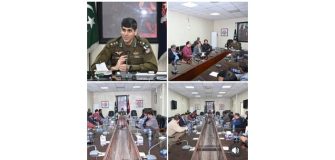
Rawalpindi (Digital Posts) Saturday brought a different kind of activity to Police Lines Headquarters in Rawalpindi. Journalists began arriving for a meeting that marked the first formal interaction between the newly appointed City Police Officer, Dr Sardar Ghias Gul, and representatives of the media.
There was a sense of professional curiosity in the gathering. Journalists exchanged greetings, conversations unfolded across the room, and attention gradually turned towards the police chief. The meeting offered an opportunity not only to become acquainted with the new head of Rawalpindi Police but also to hear directly about his priorities, his understanding of the city’s policing challenges and the direction he intended to take.
As the meeting got underway, the conversation turned to issues that shape everyday life in a major urban centre: public safety, crime prevention, narcotics, law and order, and the public’s expectations of the police.
Dr Sardar Ghias Gul outlined his priorities, placing particular emphasis on merit, access to justice, a determined campaign against narcotics, action against gambling and vice dens, and a coordinated strategy for crime prevention. He also acknowledged the importance of the media in promoting public awareness and strengthening cooperation between the police and the community.
The setting itself was significant. Police Lines Headquarters represented the institutional face of law enforcement, while the journalists present represented the public’s right to information and the media’s responsibility to scrutinise public institutions. Bringing these two constituencies together provided an opportunity for a constructive exchange of ideas.
Rawalpindi is a city of considerable diversity and constant activity. Its busy commercial districts, residential neighbourhoods, educational institutions, transport networks and expanding urban settlements present a complex environment for law enforcement. Every day, thousands of people depend, directly or indirectly, on an atmosphere of security and public order.
For the police, this responsibility extends well beyond responding to criminal incidents. It includes keeping streets safe, protecting vulnerable communities, maintaining public confidence and ensuring that citizens have an accessible channel through which their grievances can be addressed.
One of the central themes of the CPO’s address was merit.
In a professional police organisation, merit is the foundation of effective administration, institutional discipline and operational efficiency. Appointments based on professional ability, responsibility and performance help create an environment in which officers can concentrate on their duties and pursue clearly defined objectives.
When professional competence is encouraged at every level, from the police station to senior command, the entire institution benefits. It also strengthens public confidence in the fairness and consistency of police decisions.
Another major priority was the campaign against narcotics.
Drug abuse is among the most serious social challenges facing contemporary societies. Its consequences extend far beyond individual users, affecting families, educational institutions and the wider social fabric. Protecting young people from drug trafficking and addiction therefore requires sustained attention, effective law enforcement and close cooperation among public institutions and local communities.
A comprehensive response must address not only those involved in the street-level distribution of narcotics but also the networks that sustain the trade. Intelligence-led operations, public awareness and cooperation with educational institutions can all contribute to a more effective strategy.
The CPO’s stated intention to take action against gambling and vice dens also reflects the importance of maintaining a safe and orderly urban environment. Consistent enforcement, guided by law and applied without discrimination, remains essential to public confidence in the justice system.
The meeting also highlighted the constructive role the media can play in this process.
The relationship between journalism and law enforcement is an important part of a functioning public information system. Journalists report developments, highlight community concerns and help citizens understand the work of public institutions. Police departments, in turn, can use professional engagement with the media to provide accurate information, address public concerns and promote awareness of safety initiatives.
Such cooperation is most effective when founded on mutual respect, professional independence and a shared commitment to the public interest.
The meeting at Police Lines Headquarters was therefore more than an introductory engagement. It provided a platform for the police leadership and the media to establish communication and identify areas in which cooperation could contribute to a safer and better-informed community.
For Dr Sardar Ghias Gul, the occasion offered an opportunity to outline the priorities and principles that will guide his leadership of Rawalpindi Police. For the journalists, it was an opportunity to hear the police chief’s perspective and gain a clearer understanding of his approach to the challenges facing the city.
Ultimately, the success of any policing strategy is reflected in the everyday lives of citizens: safer neighbourhoods, greater public confidence, timely assistance and the assurance that the law protects everyone equally.
As the Saturday meeting drew to a close, one message stood out: effective policing is a collective responsibility, requiring professional leadership, dedicated personnel, informed citizens and a responsible media.
The police uniform represents authority, but its greatest strength lies in public trust. That trust is not established through words alone; it is earned through consistent service, fairness and a genuine commitment to the people.
For a city like Rawalpindi, that is a vision worth pursuing.