
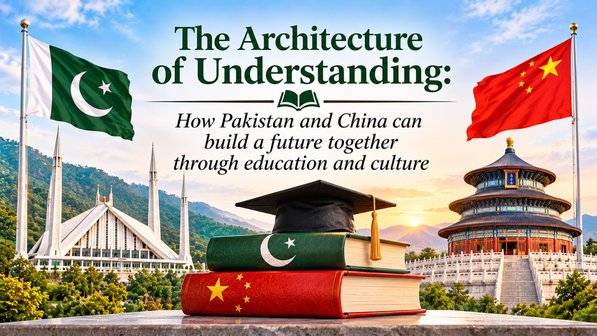
ISLAMABAD (Digital Posts) The Architecture of Understanding: How Pakistan and China can build a future together through education and culture

Share
Written By Ms. Zarmina Ali Khan, a Participant of ICSF-SBBWU Fellowship Programme 2026-2027
ISLAMABAD (Digital Posts) “The friendship between the peoples is the foundation of state-to-state relations.”
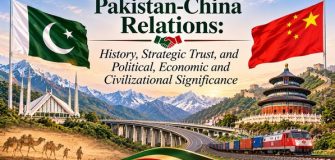
Picture a Pakistani student in Shanghai enjoying Peking duck with his Chinese classmate, exchanging stories, laughter and languages. No treaty is signed, no agreement is made but still something valuable is being shaped, these small exchanges become an opportunity for cultural exchange connection. The diplomatic relations between Pakistan and China have begun from 1951 and this partnership is on the basis of strategic trust, defense cooperation and most importantly on the recent project China Pakistan Economic Corridor (CPEC) in which China has invested tens of billions of dollars. These seventy years this friendly relationship is visible through their successful on run projects of roads like Karakorum highway phase II, Peshawar Karachi motorway, power plants like Sahiwal Coal Power Plant, Port Qasim Coal Power Plant and ports like Gwadar port and Port Qasim and Karachi port expansion. The next phase of China Pakistan cooperation can reach to the high level by investing not only in infrastructure but also in promoting cultural understanding and people to people ties.
The theory of soft power by Nye’s (2004) states that the relationship between attraction and international influence is central similarly Kurlantzick (2007) and Wang (2008) explored how China has used its cultural diplomacy to deepen its engagement with the world. The mutual attraction becomes more meaningful when both sides contribute in exchange of culture, respect and curiosity. For years the relation between Pakistan and china has been strengthened through diplomatic engagements and a shared vision of cooperation. Yet the true depth of this friendship will depend on how meaningfully it reaches beyond their government institutions to becoming a part of everyday life. One of the platforms where these transformations can take place is universities, research centers and classrooms. When a Pakistani and Chinese student encounter each other histories, language, culture, literature, the relation becomes deeper human dimension. Such exchanges should move in both directions letting each nation become a teacher and a learner. The bond of Pakistan China friendship will not only measured in agreements signed by their leaders but also by the connection the people are having across the border.
Language is the foundation of cooperation and mutual understanding, many Mandarin institutes in Pakistan are being supported by universities like Confucius Institute at the University of Karachi providing an initial point for expanding Chinese language across vocational centers and schools. In this way the access to professional opportunities would be more than having an economic bilateral relation. At the same time Chinese universities can also promote Urdu and south Asian exposure programs, creating more opportunities for cultural and academic engagement. Such exchanges would make the friendship more meaningful when both the societies make efforts in communicating and try to understand each other.
Where the knowledge is shared the discoveries are greater, the academic cooperation of the forthcoming era cannot only be measured by how many students cross the border but by how much knowledge they make together. The dynamics of Karakorum glacier, water security challenges, sustainable agriculture, renewable energy and public health makes a meaningful point for having such collaborations. Making an opportunity for jointly supervised PhD programs, dual degree programs and shared research centers can strengthen their partnership more. Pakistan and China can make an academic bond where the ideas of both the societies circulate freely making an equitable recognition for their academic contributions.
Cultural exchange a way of connecting hearts, the story of Pakistan China friendship has not begun through their present diplomacy, back in times Chinese monks and scholars like Faxian and Xuanzang travelled the Gandhara civilization documenting Buddhist knowledge and cross cultural interaction across distant lands. This illustrates an older connection between them. This shared historical legacy should be brought back to public attention by making joint documentaries, museum collaboration and Silk Road heritage initiative. So both the countries can have a transformation from a shared history into living cultural connections.
The collaborative minds are where the future belongs, a substantial cooperation requires more than institutional agreements. It needs a space where emerging voices can contribute to mutual ideas. By upbringing fellowships, youth led parliamentary initiatives and think tanks can provide greater ideas. By encouraging constructive discussions, these initiatives can form mutual understanding and establishing respectful bilateral connections.
A partnership becomes stronger when the opportunities provided by them are accessible. It should have transparent academic and financial arrangements, supportive environment where students can having more exposure and develop new things connecting education with professional opportunities. The education sectors should extend to areas like Balochistan and Gilgit Baltistan ensuring that the benefit of the connectivity is should be given to the local universities. UNESCO’s (2021) focused on solidarity, cooperation and shared responsibility offering a valuable guiding principle for shaping a future of education.
A compact of bilateral education and culture can shape this vision into practical direction. It is gateway of opportunities for students to learn and work across the borders. They can establish joint research centers which can work on climate, water and public health encouraging the language exchange and create shared guidelines that can ensure the academic freedom.
Pakistan and china have already made a remarkable diplomatic relation through their strategic cooperation and economic engagement. A mission ahead is to build a foundation of a stronger education institutes, collaborative research centers, cultural exchange and engagement between people. The next channel between these two nations needs not only to be built on the basis of steel and asphalts but through new ideas and understanding.