

ISLAMABAD (Digital Post) On August 27, 2005, a policeman did not really die. He is still on duty.

Share
ISLAMABAD (Digital Post) On August 27, 2005, a policeman did not really die. He is still on duty.
The only difference is that twenty-one years ago, there was a gun in his hands. Today, there is nothing in them. Twenty-one years ago, he stood face to face with terrorists at Islamkot. Today, police officers stand before his grave, listening to the silent testimony of his sacrifice.
His name was Amir Afzal.
He was a constable.
He had neither the authority of a senior rank nor a protocol convoy, no sirens and no privileges. He had only his uniform, his duty and the courage to give his life for his country.
And those three things proved to be enough.
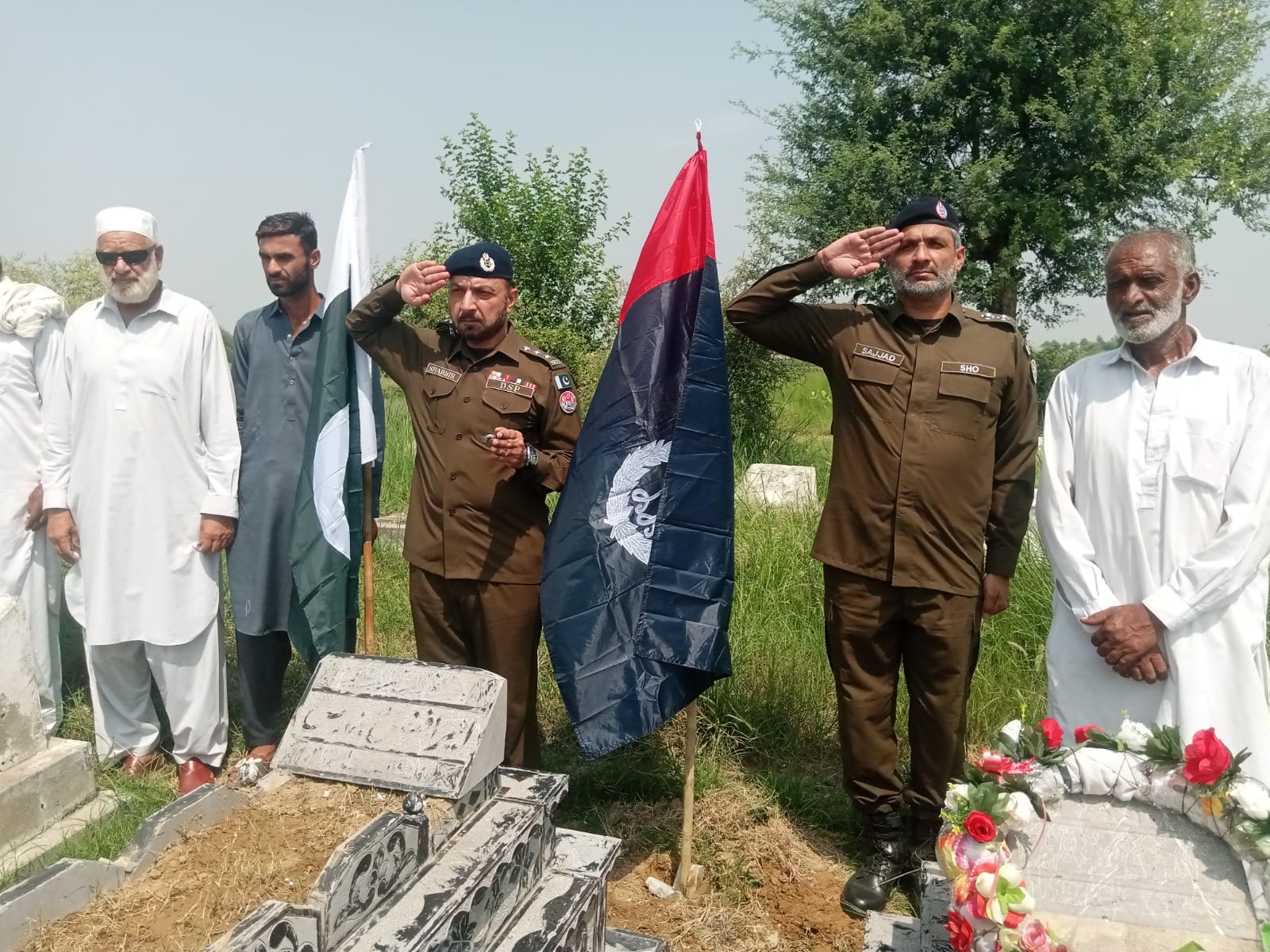
Twenty-one years later, when a smartly turned-out contingent of Attock Police arrived at his grave, one question seemed to rise above the silence:
Why does the grave of an ordinary constable still matter so much to the police after twenty-one years?
The answer was not in the floral wreath.
It was not in the salute.
It was not even in the raised hands reciting prayers.
The answer lay beneath that silent earth which, twenty-one years ago, received the body of a young policeman but never buried his sense of duty.
That is what sacrifice means.
That is the moment when a police uniform ceases to be merely a piece of cloth and becomes a covenant.
And that is also the moment when an ordinary constable becomes far greater than his rank.
Amir Afzal remains a name larger than any serving policeman because he completed his final duty at a place from which there was no road back.
On August 27, 2005, an encounter took place at Islamkot. Bullets were fired. On one side was terror; on the other stood a man in uniform.
And then a policeman made a choice.
He chose not to retreat.
Amir Afzal was martyred.
In Pakistan, stories of sacrifice are often buried within a few lines of newsprint. A report appears in the newspaper, a photograph is published, officers issue statements of condolence—and within days, another story pushes the old one out of the headlines.
But in the home of a martyr, the news never grows old.
August 27, 2005, still exists there.
Perhaps a door still opens in the same way.
Perhaps a voice is still remembered calling someone’s name.
Perhaps a photograph still hangs on a wall.
And for a mother, a father, a wife or a child, the question may still be the same after twenty-one years:
Why did he never come back?
There is no answer to that question in a government file.
The answer exists only in sacrifice.
That is why Attock Police’s visit to Amir Afzal’s grave was not merely a ceremonial obligation. It was a meeting with its own past.
When DPO Attock Captain (Retd.) Ali bin Tariq stood at the grave alongside his men, he was sending a message to the entire force: a policeman who dies in uniform does not become merely a name in a record. He becomes the institution’s enduring responsibility and collective memory.
And the presence of DSP Fateh Jang Khan Shabbir carried an even more personal meaning.
A commander standing at the grave of a fallen comrade does not merely lay flowers. He makes a silent promise to the living men under his command:
You are not alone.
If duty ever takes you to the same place, your institution will remember you.
Your name will not be locked away in a file.
Time will not erase your sacrifice.
And one day, men in uniform will stand at your grave as well.
Perhaps this is why the martyrs in the history of a police force are never merely part of its past.
They become guardians of its future.
Amir Afzal’s grave may be twenty-one years old, but its message is as fresh as ever.
It tells us that the war against terrorism is not fought only in operation rooms, at checkpoints, during raids or through weapons. Its real strength lies in the man who knows that death is standing in front of him—and still takes one step forward.
Amir Afzal took that step.
Today, the policemen standing at his grave may not be able to see him, but his sacrifice is watching them.
Perhaps this is the strangest bond between the dead and the living.
The living come to see the martyr, but in reality, it is the martyr who is watching the living.
He is watching who is protecting the peace for which he gave his life.
He is watching where the dignity of the uniform stands.
He is watching whether the men who came after him still possess the courage that once carried him into the line of fire.
With Captain Ali bin Tariq and Khan Shabbir present, Attock Police renewed that commitment: the mission of its martyrs has not ended.
The battle for peace continues.
The fight against crime continues.
The war against terrorism continues.
And so does the test of the uniform.
Twenty-one years ago, Amir Afzal completed his part.
Now the responsibility belongs to those standing beside his grave.
So if someone asks what lies beneath a twenty-one-year-old grave, the answer is simple:
Not merely a body. An unfinished covenant.
And it is the duty of Attock Police to keep that covenant alive.
Because the finest tribute to a martyr is not a wreath.
It is to carry forward the mission for which he gave his life.
There is still earth upon Amir Afzal’s grave.
But beneath that earth, a question remains alive:
If the country needs another Amir Afzal today, are we ready?
That is the question standing before every man in uniform.
And perhaps that is why, twenty-one years later, the grave is still not silent.