

ISLAMABAD (Digital Post) What the Saudi Arabia–Türkiye–Pakistan Mecca Joint Defense Agreement Means for Azerbaijan

Share

By Ms. Anastasiya Lavrina, Research Fellow at the Institute for Development and Diplomacy of ADA University, Azerbaijan and Political Analyst
ISLAMABAD (Digital Post) For decades, the security architecture of the Middle East was shaped largely by powers outside the region. Foreign military bases, naval deployments, external mediation, and security guarantees from major global actors became defining features of the regional order. Today, however, that model is gradually changing. The Middle East is becoming less willing to rely exclusively on outside powers and increasingly determined to shape its own security environment.
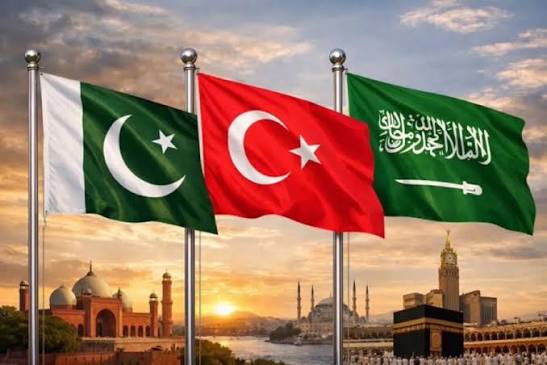
The defense agreement between Saudi Arabia, Türkiye, and Pakistan should be understood against precisely this backdrop. Its significance goes beyond closer military cooperation among three influential Muslim states. It reflects a broader shift toward strategic autonomy, in which regional actors are seeking to supplement their traditional partnerships with mechanisms of their own.
This does not mean that the role of global powers is disappearing. Türkiye remains a NATO member, Saudi Arabia maintains a deep security relationship with the United States, and Pakistan continues to pursue a complex network of strategic partnerships. What is changing is the degree to which major regional states are willing to rely on a single security framework. Increasingly, they are diversifying not only their economic and diplomatic relations, but their defense relationships as well.
The composition of the new format makes it particularly significant. Türkiye brings military capability, a rapidly expanding defense industry, and geopolitical reach from the Black Sea and Eastern Mediterranean to the Middle East and Central Asia. Saudi Arabia contributes financial power and political influence across the Arab and Islamic worlds. Pakistan adds considerable military experience and the strategic weight of a nuclear-armed state.
Taken together, these countries connect several geopolitical spaces that have traditionally been treated separately: the Eastern Mediterranean, the Red Sea, the Gulf, the Arabian Sea, and South Asia. That geographical reach may ultimately prove as important as the formal defense commitments themselves.
The agreement also comes at a time when the concept of security is becoming broader. Military power remains indispensable, but strategic resilience increasingly depends on energy infrastructure, maritime routes, ports, transport corridors, digital networks, and secure supply chains. In that sense, closer cooperation among Ankara, Riyadh, and Islamabad could eventually develop beyond conventional defense into a wider strategic partnership.
It is at this point that the agreement becomes particularly relevant for Azerbaijan. Two of the three participants in the new agreement already hold a special place in Baku’s foreign and security policy. Türkiye is Azerbaijan’s ally under the Shusha Declaration, while Pakistan has become one of its closest strategic partners, with cooperation extending across political, diplomatic, defense, and security spheres. At the same time, Azerbaijan has significantly strengthened its relations with Saudi Arabia and the wider Gulf region, particularly in investment, energy, renewable resources, and economic cooperation.
This places Azerbaijan in a uniquely advantageous position. Baku enjoys close and trusted relations with all three countries while remaining outside the emerging framework itself. That allows Azerbaijan to benefit from the growing strategic convergence among its partners while preserving the independent and balanced foreign policy that has become one of the country’s defining characteristics.
Under the leadership of President Ilham Aliyev, Azerbaijan has undergone a profound strategic transformation. Following the restoration of its territorial integrity and full sovereignty, the country’s foreign policy entered a new phase. On 8 August 2026, Azerbaijan marked the first anniversary of the Washington agreements between Azerbaijan and Armenia—a diplomatic milestone that opened a path toward the normalization of relations after decades of conflict. Having achieved victory on the battlefield and subsequently advanced a peace agenda, Azerbaijan demonstrated that the restoration of sovereignty can become the foundation for long-term regional stability rather than a source of renewed confrontation.
This transformation has considerably expanded Azerbaijan’s international role. Today, Baku simultaneously deepens its alliance with Türkiye, strengthens strategic cooperation with Pakistan, broadens partnerships with the Gulf states, enhances connectivity with Central Asia and China, remains one of Europe’s key energy partners, and maintains pragmatic engagement with the United States and other major international actors. Rather than aligning itself exclusively with one geopolitical center, Azerbaijan has consistently pursued a policy of strategic autonomy while developing constructive relations with multiple partners.
The Washington process also illustrated an important feature of Azerbaijan’s diplomacy. Baku’s commitment to regional ownership does not exclude the constructive involvement of global powers when such engagement contributes to lasting peace and mutually beneficial outcomes. Instead of treating regional initiatives and international mediation as competing approaches, Azerbaijan has demonstrated an ability to combine both in pursuit of stability, sovereignty, and long-term development.
In an increasingly polarized international environment, this diplomatic flexibility has become one of Azerbaijan’s greatest strategic assets.
The same principle applies to connectivity. The Middle Corridor, linking Central Asia with Europe through the Caspian Sea, Azerbaijan, Georgia, and Türkiye, is no longer simply a transport route. It is steadily becoming an essential component of Eurasia’s economic resilience and broader security architecture. Reliable logistics, secure energy infrastructure, and uninterrupted transit corridors are increasingly viewed as strategic assets that contribute directly to regional stability.
For Azerbaijan, the agreement is also important because greater strategic coordination among key regional powers may contribute to a more stable security environment at a time when the Middle East continues to deal with the consequences of the recent conflict involving Iran. Any mechanism capable of reducing the risk of renewed regional escalation, strengthening political dialogue, and encouraging greater regional responsibility for security creates more favorable conditions for peace and stability across the broader neighborhood. For Azerbaijan, which shares close political, economic, and geographical links with the Middle East, such stability is not merely desirable—it is a strategic necessity.
Ultimately, the significance of the Saudi Arabia–Türkiye–Pakistan agreement extends beyond defense cooperation. At a time when the Middle East continues to deal with the consequences of recent conflicts, any initiative that strengthens regional responsibility, encourages dialogue, and reduces the risk of future escalation contributes to a more stable regional environment. For Azerbaijan, which under the leadership of President Ilham Aliyev has progressed from restoring its sovereignty to advancing a peace agenda, this transformation is particularly significant. It reinforces the vision of a region where lasting security is built through cooperation, connectivity, and mutual respect for sovereignty.