


ISLAMABAD (Digital Post) Drone Hunter Anti-Aircraft System, Pakistan Self-reliant in National Defense

Share
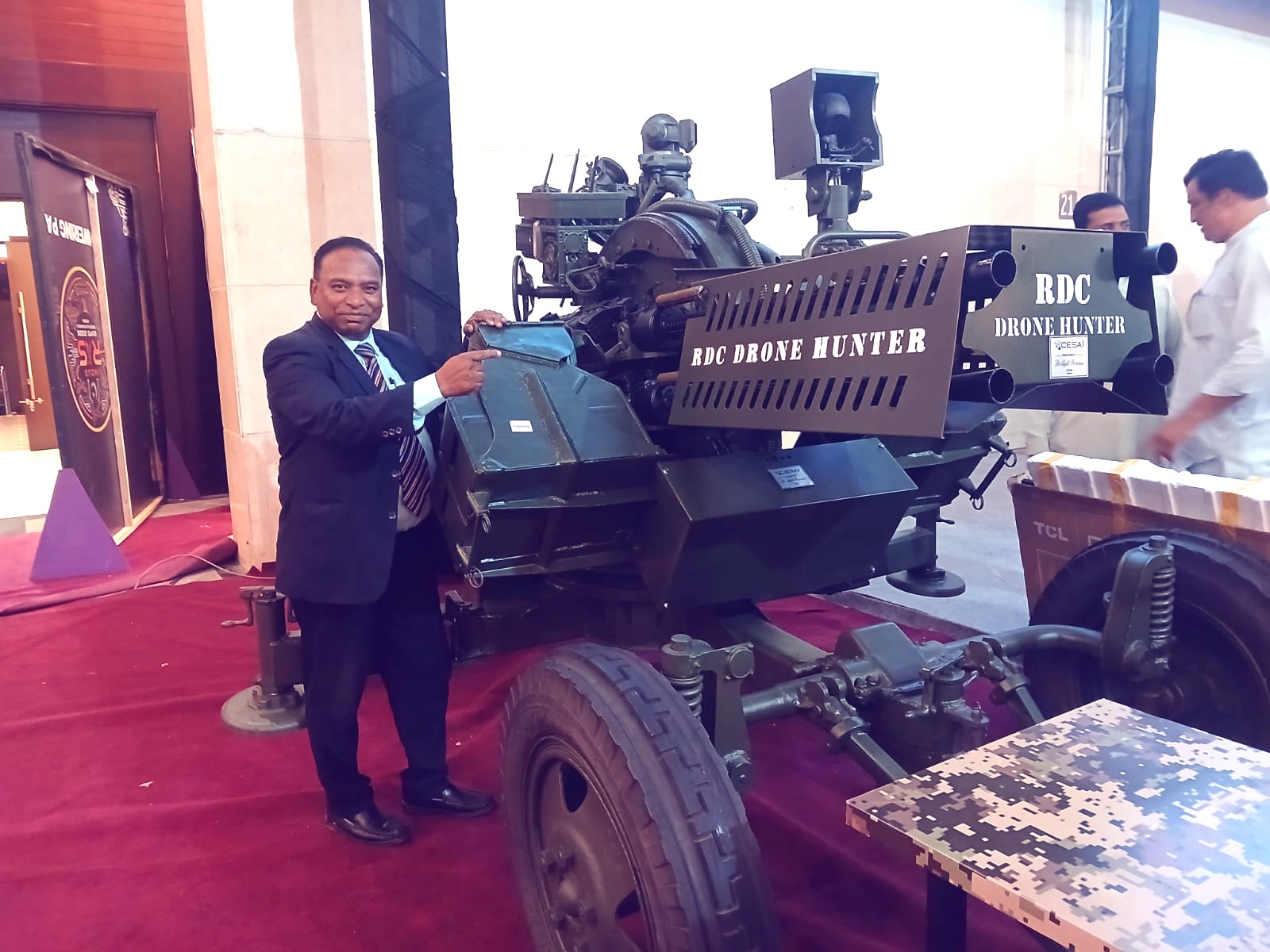
ISLAMABAD (Digital Post) Pakistan has made great progress towards self-reliance in defense technology, which was clearly evidenced at the Indus RAS Expo 2026 recently held in Islamabad. According to Prime Minister Shehbaz Sharif and defense officials, the country has crossed important milestones using local resources. All military and air training simulators presented at the defense exhibition are 100 percent manufactured in Pakistan. Pakistan has made significant progress in developing indigenous autonomous systems in defense technology and national security. According to recent exhibitions and government announcements, the country is rapidly incorporating the latest robotics, artificial intelligence (AI), and autonomous systems into its defense infrastructure. Pakistan has made great progress in the manufacturing of drone technology, where more than 60 percent of components are being manufactured locally. The “Indus RAS Expo” held in July 2026 showcased the latest drone interceptor developed by Pakistani company Gradient Aerospace, which is capable of disabling enemy drones in the air. The exhibition aims to position Pakistan among the leading countries in modern defense and civilian technology of the 21st century. The Pakistani Armed Forces have introduced simulators that are 100 percent manufactured and assembled in Pakistan to enhance combat training and operational skills. Recently, automated defense systems equipped with cybersecurity and artificial intelligence have been effectively used to protect the borders under the supervision of the military leadership. The government is preparing special legislation and frameworks to promote autonomous capabilities and bring AI into the legal scope of the defense system. This defense technology of Pakistan is not only making the country’s sovereignty inviolable but is also opening new avenues for future exports in the fields of robotics and artificial intelligence. Prime Minister Shehbaz Sharif has said that in the war of justice, the armed forces defended the country’s borders through modern technology, autonomous systems and cybersecurity. Addressing the Indus Robotics and Autonomous Systems Expo ceremony in Islamabad, the Prime Minister said that this exhibition and such initiatives will help Pakistan to be among the leading countries in modern technology of the 21st century. The Prime Minister said that the use of technology in the security sector is a matter of pride; Pakistan has achieved significant achievements in the field of modern technology, and more than 60 percent of the preparation of drones has been completed locally. During the Battle of Haq, the armed forces under the leadership of Field Marshal Syed Asim Munir used modern technology effectively, while the support of the Air Chief and Naval Chief under the leadership of the Field Marshal was also commendable. In the Battle of Haq, the armed forces demonstrated their defense capabilities through autonomous systems and cybersecurity. Pakistan will further promote the use of modern technology to defend its sovereignty and protect national security. More than 60% of the materials used in the manufacturing of drones used for modern defense and surveillance purposes are being produced locally. Cutting-edge autonomous systems: Military engineers and startups have introduced the ‘Drone Hunter’ anti-aircraft system equipped with artificial intelligence (AI) and autonomous naval and land robotic systems, which make the defense of physical and cyber borders impregnable. To further promote this ecosystem of technology and transfer defense technology to commercial sectors, the government has also announced a $20 million ‘Pakistan Venture Fund’. —RDC Drone Hunter Anti-Aircraft System “received great acclaim during the Quands RAS Expo 2026; it is being considered a game-changing technology to counter the growing drone threats and hybrid warfare on Pakistan’s western and eastern borders. This effort by Pakistani engineers and researchers has been described as a major step towards making the country’s defense self-sufficient,” RDC said. Drone Hunter is the physical embodiment of our post-war adaptation. The 2025 conflict proved that future wars will not be won by heavy weapons alone, but by whoever dominates the lower airspace. This system secures that border. The locally upgraded iPad RDC ‘Drone Hunter’ anti-aircraft system (RDC Drone Hunter) received a huge response from fans, defense experts, and the media at the Indus Robotics and Autonomous Systems Expo 2026 (Indus RAS Expo) held in Islamabad. The conventional 14.5mm quad anti-aircraft gun platform developed by Russia (which has been in use by the Pakistan Army since 2000) has been repurposed by equipping it with advanced artificial intelligence (AI) and an automated targeting system. The system has a drone detection range of 8 km, while it can successfully target enemy quadcopters and drones up to a distance of 2 km.This monster machine has an extraordinary ability to fire 2,400 rounds per minute (RPM), which is impossible for any drone to escape. The detailed technical information of the leading-edge defense weapons, radar systems and drone models presented at the IndusRAS Expo is as follows: Counter-UAS and Radar Systems Pakistani defense firm UAS Global (UAS-G) has introduced an integrated anti-drone portfolio at the exhibition: X-Band Surveillance Radar: This state-of-the-art radar system is specifically designed to track small and commercial drones flying at low altitudes, eliminating the ‘blind spots’ of traditional radars. Multi-Constellation Navigation Spoofer: It can hack the GPS or navigation signals of an enemy drone and divert it or make it land at a desired location. Long Range Omni-directional jammer: Completely blocks all communication links of enemy drones within a specified radius. Laser-guided and logistic drone models Shahpar-II armed drone: This drone, developed by GIDS, is now part of the regular fleet. It is capable of flying at an altitude of 21,000 feet, has a range of 1,050 km, and can carry out precision strikes on the ground with two ‘Barq’ laser-guided missiles developed by NESCOM. 100 kg logistics drone: A hybrid human-sized drone was also displayed at the expo, which can deliver equipment or ammunition weighing up to 100 kg to remote outposts on the battlefield or in emergencies. Anti-drone laser weapon (Silent Hunter): Details of the Chinese-made ‘Silent Hunter’, which was included in Islamabad’s priority list, were also shared during the expo: Laser gun technology: This is a high-power laser weapon mounted on a pickup truck that burns any drone within a distance of about 1 kilometer in seconds by firing an intense laser beam, without conventional bullets or missiles. Local drone engine (UAV Propulsion System) AKAL Piston Engines: Four small piston engines, including the A-MD550, designed and manufactured in Pakistan for the first time under the Alsons Group, were presented. These provide power to target drones and loitering munitions, which has eliminated dependence on foreign countries. “Expo 2026 concluded its final session at the Pak-China Friendship Centre with significant technological advances, a much cheaper and more lethal solution developed by upgrading older conventional weapons compared to expensive anti-drone missiles.”
The state-of-the-art defence system was developed rapidly by Pakistan’s Research and Development Command (RDC) following key lessons learned during the four-day Indo-Pak war of May 10, 2025. The conflict, historically framed as a battle of wits, highlighted a paradigm shift towards hybrid, drone-dominated warfare, highlighting the urgent need for fast, cost-effective counter-UAS (Unmanned Aircraft System) arrays.
Our on-ground correspondent Asghar Ali Mubarak observed the concluding session with leading regional defence experts Engineers Zulqarnain Bashir and Kamran Khan, who reviewed the newly introduced, automated RDC Drone Hunter anti-aircraft system. The newly developed platform represents a master class in modernizing retired hardware through intelligence. The system uses a retired, heavy-duty Russian-designed 14.5mm quad anti-aircraft gun chassis as its primary kinetic foundation. RDC engineers completely stripped away manual controls, integrating an automated, AI-assisted targeting system designed to track and lock on to high-speed suicide drones and low-altitude weapons. Operational capabilities: Detection range: 8 km. Effective engagement range: approximately 2 km. Firing capacity: 2,400 rounds per minute at a velocity of 1,000 meters per second. Expert analysts Zulqarnain Bashir and Kamran Khan noted during the presentation that the system offers a highly sustainable economic model for airspace defense. The combination of inexpensive, abundant 14.5mm kinetic ammunition with highly sophisticated AI radars means that, by doing so, Pakistan can neutralize incoming commercial-grade Swarm drones without expanding its expensive missile arsenal.
The rapid development cycle of the RDC Drone Hunter was directly dictated by the events of the spring 2025 border crisis. Between May 6 and May 10, 2025, hostilities escalated rapidly across the Line of Control. The conflict witnessed an unprecedented scale of coordinated drone strikes targeting critical infrastructure and military positions. While Pakistan’s coordinated cross-domain response—led by Field Marshal Syed Asim Munir—successfully repelled the infiltration before the US-brokered ceasefire took effect on the evening of May 10, the heavy reliance on locally-based unmanned combat assets by both factions has reshaped Pakistan’s military doctrine. The successful unveiling of the two-day landmark system at the Indus RAS Expo solidified the shared vision of the Ministry of IT and Telecommunication and Ignite to transform Pakistan into a self-reliant exporter of advanced autonomous hardware. Earlier, Prime Minister Muhammad Shehbaz Sharif formally inaugurated the Indus RAS Expo 2026 at the Pak-China Friendship Center in Islamabad. The event marked a decisive pivot towards local hardware manufacturing, with state officials revealing that 100% of the simulators on display were locally manufactured and over 60% of the operational drones are now locally manufactured. To maintain this momentum, the Prime Minister announced the establishment of a $20 million Pakistan Fund. A framework to directly catalyze commercial investment in the country’s growing hardware startups. The government launched a $20M state-backed venture fund to invest in early-stage physical tech startups. Compared to expensive anti-drone missiles, this is a much cheaper and more lethal solution developed by upgrading older conventional weapons.