
Islamabad (Digital Post) Intelligence Agencies Obtain Evidence of Alleged Foreign Links of Banned Action Committee

Islamabad (Digital Post) According to credible sources, intelligence agencies have reportedly obtained evidence of alleged foreign links involving the banned Jammu Kashmir Joint Awami Action Committee. An intelligence report submitted to the government claims that the movement, which initially emerged in Azad Jammu and Kashmir as a protest against higher electricity tariffs and flour prices, gradually evolved into what it describes as a foreign-backed campaign aimed at weakening Pakistan’s position on Kashmir and targeting state institutions.
According to the report, there is what it describes as “credible evidence” indicating that hostile intelligence agencies and other foreign elements, particularly through networks based in the United Kingdom and Europe, allegedly provided financial, media, and organizational support to benefit from the movement.
The report states that the committee’s campaign moved beyond socio-economic demands and developed into a political movement that challenged the constitutional framework of Azad Jammu and Kashmir. It says these demands included the abolition of the 12 refugee seats reserved in the Azad Jammu and Kashmir Legislative Assembly and calls by some leaders to remove the constitutional oath affirming accession to Pakistan from the electoral process.
According to the report, the refugee seats were established to ensure the political representation of refugees from Indian Illegally Occupied Jammu and Kashmir (IIOJK). It argues that while constitutional reforms can be debated through political forums, threats to disrupt elections and reject constitutional provisions amount to political coercion.
The report outlines the evolution of the movement through two major protest campaigns. It states that the May 2024 Long March resulted in government relief measures on flour and electricity prices but ended in violence in which one law enforcement official was killed and three civilians lost their lives.
It further states that during the second Long March, held from 29 September to 4 October 2025, seven civilians and three law enforcement officials were killed. Following this, an agreement was reached on 4 October 2025 through federal mediation. According to the report, most clauses of the agreement have either been implemented or are in the process of implementation. However, it alleges that the banned Action Committee later changed its demands instead of adhering to the agreement.
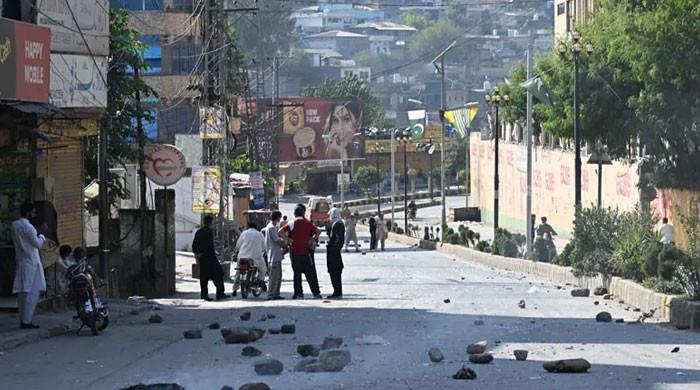
The report also refers to tensions preceding the announced 9 June protest and states that the Government of Azad Jammu and Kashmir declared the Action Committee a banned organization under anti-terrorism laws following violent clashes in which four law enforcement personnel were killed and another 32 were injured.
Security agencies further claim that protesters used sticks, stones, and firearms during the clashes while also taking advantage of the mountainous terrain of Azad Jammu and Kashmir.
The report additionally alleges that individuals with military backgrounds and their armed associates were present at protest sites.
A significant section of the report focuses on what it describes as an extensive overseas campaign supporting the banned Action Committee. It states that demonstrations were held outside Pakistani diplomatic missions in London, other cities in the United Kingdom, Geneva, and outside the European Parliament to internationalize the issue.
The report alleges that Kashmiri nationalist groups, supporters of Pakistan Tehreek-e-Insaf (PTI), social media influencers, and pro-India platforms coordinated online campaigns promoting the committee’s narrative.
According to the report, contact details of journalists from international media organizations, including Al Jazeera, Sky News, Reuters, Associated Press, Bloomberg, Fox News, and DW News, were circulated through WhatsApp groups to maximize international media coverage of the protests.
It further alleges that coordinated hashtags and organized social media messaging sought to portray Azad Jammu and Kashmir as facing a human rights crisis while remaining silent on alleged Indian actions in Indian Illegally Occupied Jammu and Kashmir (IIOJK).
The report specifically names the United Kashmir People’s National Party (UKPNP) as one of the most active overseas supporters of the Action Committee. It claims that the organization has long campaigned internationally against Pakistan’s administrative role in Azad Jammu and Kashmir and Gilgit-Baltistan, and used the recent protests to intensify its lobbying efforts.
It also cites the participation of a core committee member of the Action Committee in a 29 September 2025 protest organized by the UKPNP outside the Pakistan High Commission in London as evidence of growing links between the two organizations.
The intelligence report further alleges that the Action Committee received substantial financial assistance from hostile intelligence agencies through sympathizers based in the United Kingdom and Europe.
According to the report, certain business figures associated with the property, travel, and money exchange sectors allegedly provided financial support, while a significant portion of the funds was transferred through informal hawala and hundi channels.
The report also alleges that relatives of some Action Committee leaders residing in the United Kingdom helped transfer funds to activists operating in Azad Jammu and Kashmir.
It links these alleged overseas networks to broader security concerns, claiming that hostile intelligence agencies have previously used similar support structures for espionage, surveillance, target identification, financing, and targeted killings within Pakistan.
The report warns that local networks capable of organizing street protests, gathering information, and spreading propaganda could be exploited for hostile purposes.
It further alleges that, with the support of hostile intelligence agencies, armed individuals and dangerous criminal elements infiltrated the Action Committee’s protest demonstrations.
However, despite these security concerns, the report acknowledges that many ordinary citizens initially joined the Action Committee to protest genuine economic hardships rather than to support what it describes as the organization’s later political agenda.
According to the report, several members of the committee’s core leadership publicly distanced themselves from the organization after speeches delivered during the Rawalakot sit-in challenged the constitutional framework and criticized state institutions, reflecting disagreement with the organization’s changing direction.
In its conclusion, the report states that the government should continue addressing the public’s legitimate concerns through dialogue and negotiations. However, it argues that violence, movements allegedly financed from abroad, anti-state propaganda, and alleged cooperation with hostile networks cannot be accepted as legitimate democratic protest.
The report recommends that, while continuing to fulfill public welfare commitments, the government should isolate violent and allegedly foreign-backed elements and expose what it describes as external attempts to exploit internal political debates in Azad Jammu and Kashmir to weaken Pakistan’s position on the Kashmir issue.