

Lahore (Digital Posts) Energy-efficient desalination key to tackling global water crisis, expert says

Share
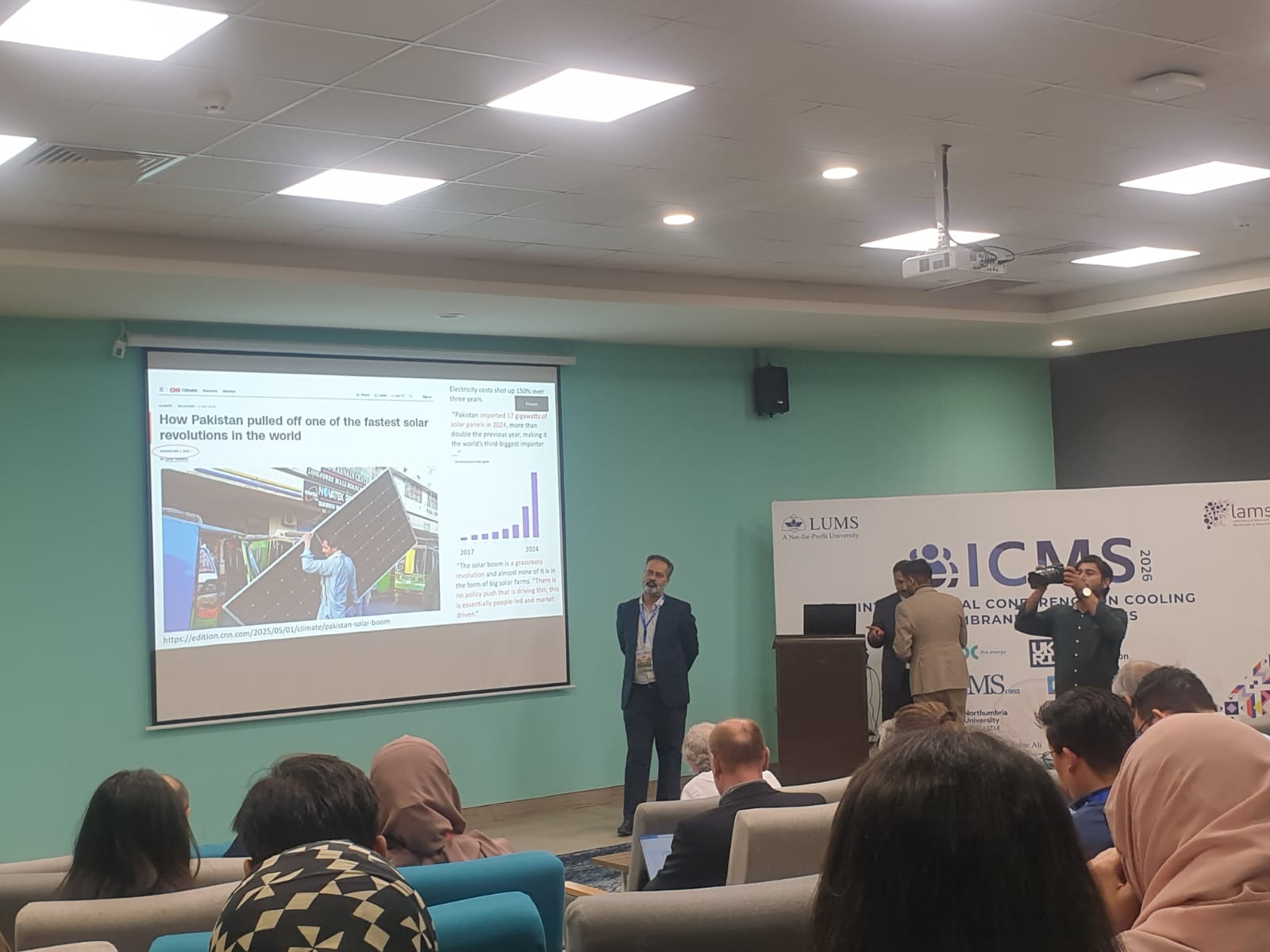
Lahore 9th April, (Digital Posts): Experts at the International Conference on Cooling and Membrane Separations (ICMS 2026), stressed the urgent need for energy-efficient desalination technologies to address growing global water scarcity. Two-day scientific gathering hosted by the Department of Chemistry and Chemical Engineering, LUMS.
 Speaking at a session on the final day, Prof. Sheng Dai of the University of Leeds, United Kingdom, highlighted the critical role of advanced membrane technologies in producing fresh water from seawater while reducing energy consumption.
He noted that despite the abundance of water on Earth, only a small fraction is available as usable freshwater, making desalination an essential solution for meeting rising demand.
“Removing salt from seawater is a thermodynamically challenging and energy-intensive process, which makes efficiency improvements crucial,” said Prof. Sheng Dai.
 Prof. Sheng Dai outlined key desalination technologies, including thermal distillation and membrane-based systems, particularly reverse osmosis, which currently accounts for the majority of global desalination output.
However, he pointed out that conventional methods remain energy-intensive and face operational challenges, prompting ongoing research into more sustainable alternatives.
 His presentation focused on innovations in membrane engineering, including the development of advanced nanocomposite membranes designed to enhance water flow while maintaining high salt rejection.
He explained that incorporating functional nanoparticles into membrane structures could significantly improve performance, though challenges such as material stability and potential contamination must be carefully addressed.
The session also explored emerging approaches such as membrane distillation and forward osmosis, which offer the potential for lower energy consumption but require further development for large-scale application. Participants noted that improving membrane efficiency and durability could play a key role in making desalination more affordable and accessible, particularly for water-stressed regions.
 The discussion underscored the importance of integrating material science, chemical engineering and technological innovation to develop sustainable solutions to the global water crisis.